AI did not create the content measurement problem. It exposed how much of marketing was already being measured on vibes.
A team can now produce five landing page variants, twenty email drafts, thirty social posts, and a dozen blog outlines before lunch. The dashboard still wants to know which campaign drove revenue. That is where the system breaks.
The paradox is simple: AI increases content output while making content accountability harder. The more variations a team ships, the harder it becomes to know what actually changed customer behavior.
Volume hides signal
Most teams start with the wrong metric. They count output.
Output feels good because it is visible. The calendar fills up. Campaigns move faster. Creative bottlenecks shrink. Executives see motion.
But measurement does not improve just because content volume increases. In many cases, it gets worse. If every channel has more posts, more emails, more variants, and more overlapping audiences, the attribution model has to explain a noisier system.
Google Analytics attribution reporting can compare known touchpoints, but it cannot see every private recommendation, forwarded link, screenshot, AI answer, or dark-social conversation that shaped the buyer. AI-generated content adds more touchpoints to a journey that was already incomplete.
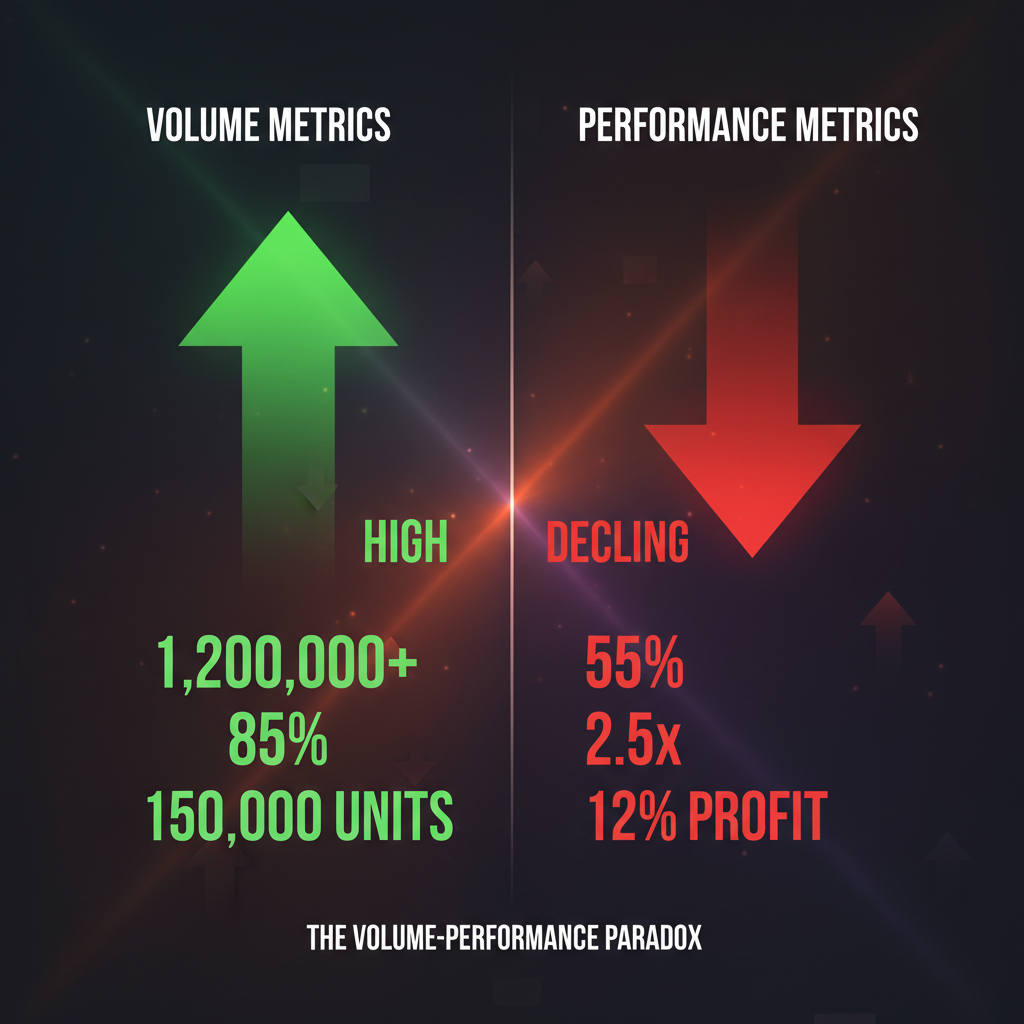
AI content volume can look productive while making the signal harder to isolate.
Personalization fragments proof
AI personalization creates another problem: it breaks clean comparisons.
One campaign used to have a small number of variants. Now a team can generate versions by segment, persona, account stage, industry, location, purchase history, and behavior. The message may be more relevant, but the measurement gets thinner because each variant has fewer comparable exposures.
That does not mean personalization is bad. It means personalization needs a proof plan.
| Old campaign measurement | AI content measurement |
|---|---|
| One email, one audience, one result | Many variants, many audiences, mixed intent |
| Campaign-level reporting | Variant and intent-level reporting |
| Last-click comfort | Directional evidence from multiple signals |
| Creative review after launch | Metadata captured before launch |
The team has to know what it is testing. If every subject line, opener, offer, audience, send time, and call to action changes at once, the result is not a test. It is fog.
The control group disappears
AI content teams often lose the control group without noticing.
Before AI, the team might compare one nurture email against another or one landing page against a previous page. After AI, the system starts adapting headlines, intros, offers, calls to action, send times, and audiences all at once. The result may improve, but the reason gets harder to isolate.
This is why marketers need to preserve control points on purpose. Keep a human-written baseline for important campaigns. Keep one stable message when testing audience variants. Keep one stable audience when testing message variants. Do not let the AI system change every variable and then call the result a learning.
There is also a brand-quality reason to keep controls. AI may improve short-term engagement by making language more familiar, softer, or more broadly appealing. That does not always mean the brand is getting sharper. A control lets the team compare not only clicks, but the quality of replies, sales conversations, lead fit, and downstream conversion.
The measurement question should be narrow enough to answer:
| Bad test question | Better test question |
|---|---|
| Did AI content work? | Did the AI-assisted objection email improve reply quality? |
| Did personalization work? | Did industry-specific proof lift demo requests for one segment? |
| Did the blog perform? | Did the source-backed explainer increase assisted pipeline? |
Without a control, the team may be optimizing the machine, not the business.
Attribution still matters
Some marketers respond to measurement difficulty by declaring attribution dead.
That is a convenient dodge. Attribution is imperfect, but budget decisions still need evidence. The better move is to stop asking attribution to do every job.
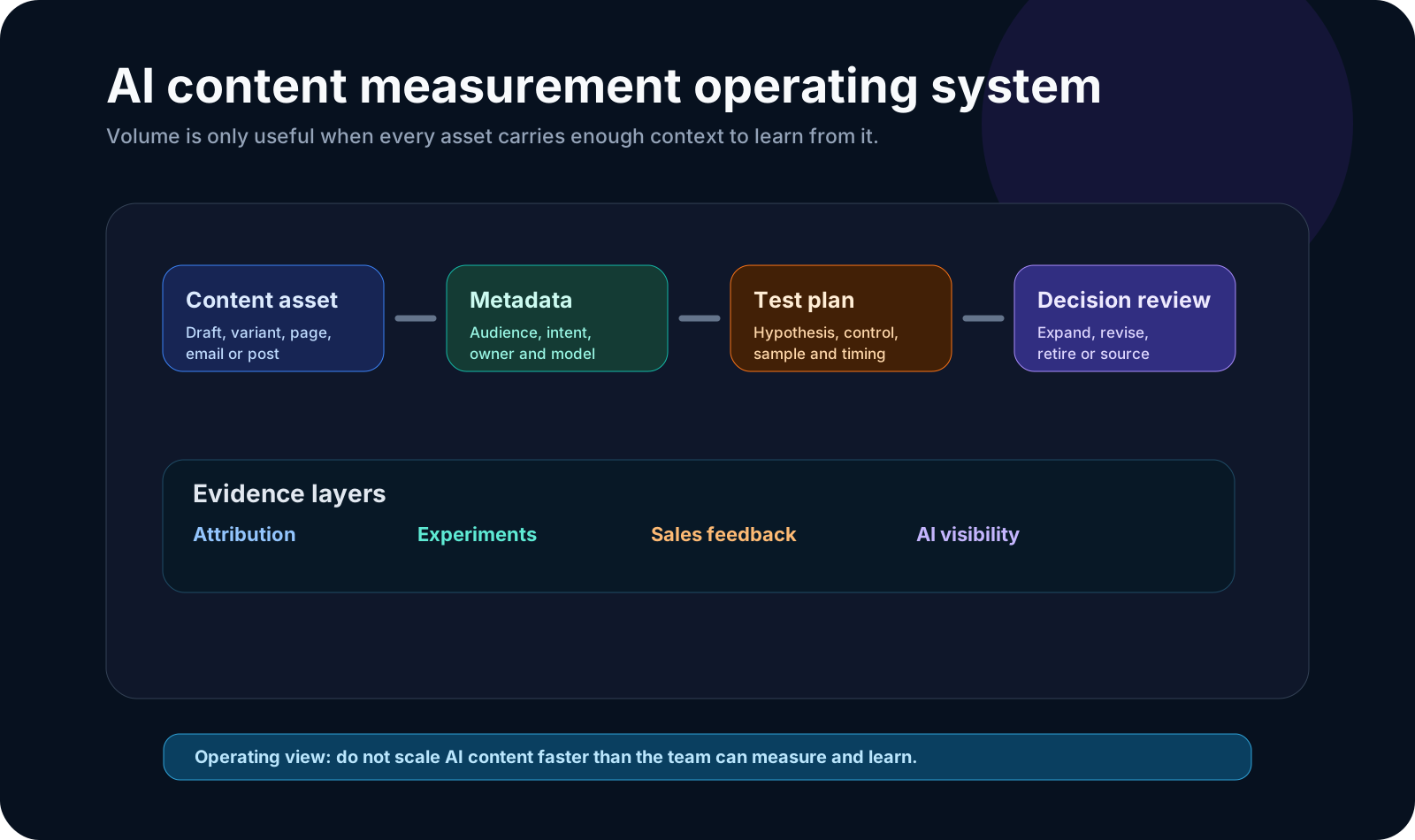
Use attribution to understand trackable paths. Use experiments to understand lift. Use qualitative evidence to understand buyer language. Use sales feedback to understand objection movement. Use AI answer monitoring to understand citation and discovery. Use content metadata to connect each asset to intent.
The measurement stack has to become layered.
The layer that gets ignored most often is buyer-language feedback. If sales keeps hearing the same objection after a content push, the content did not answer the real question.
If demo requests improve but deal quality drops, the content may be attracting the wrong audience. AI content measurement has to include those human signals because the dashboard rarely sees them in time.
The metadata problem
Most AI content has no durable record.
A prompt gets pasted into a tool. A draft gets edited. Someone publishes it. A month later, nobody knows which model produced it, what audience it was meant for, which offer it supported, which human approved it, or what assumption it was testing.
That is a governance problem and a measurement problem.
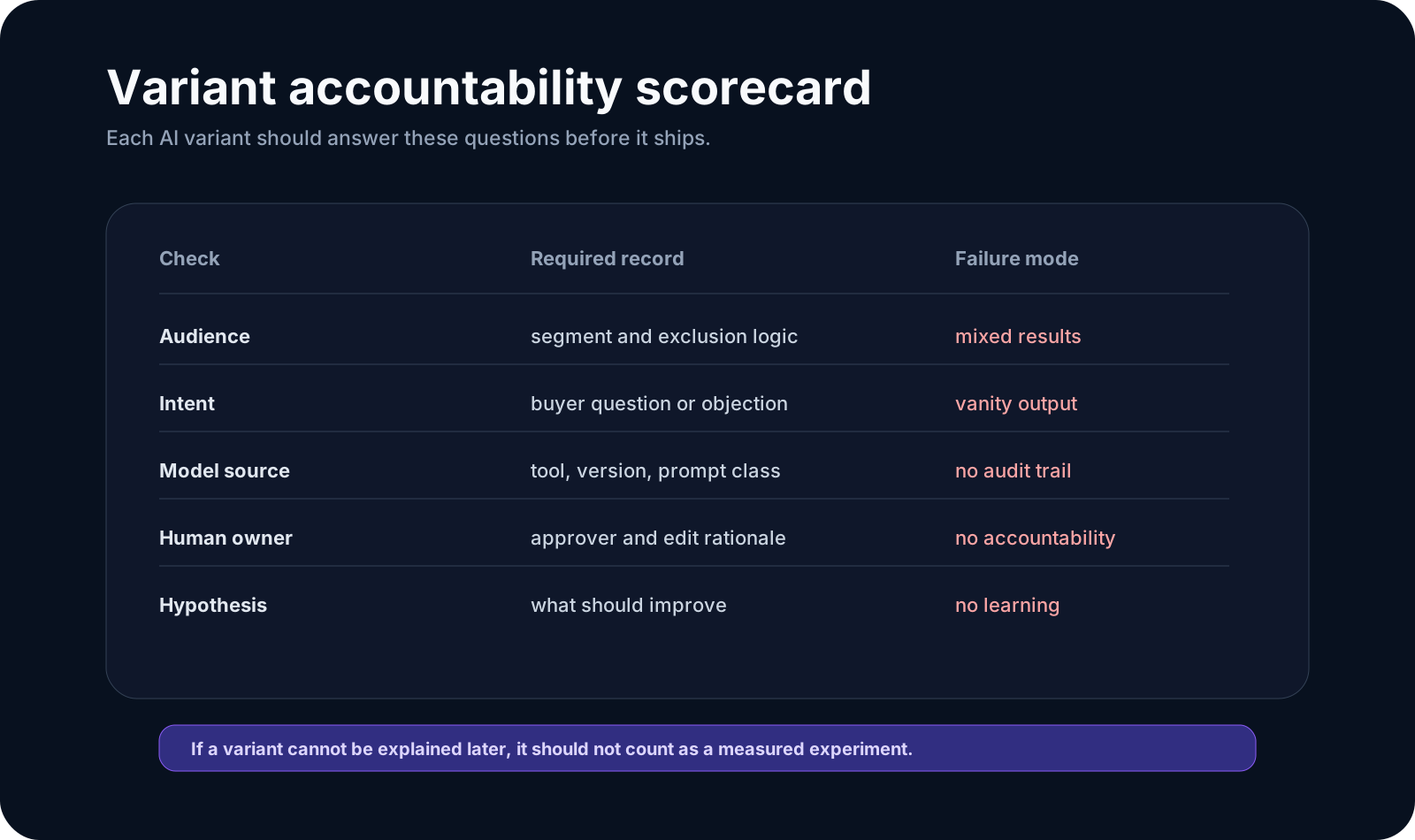
The answer is not a complicated new platform. Start with metadata every generated asset should carry:
| Field | Why it matters |
|---|---|
| Intent | Connects content to a buyer problem |
| Audience | Prevents generic performance comparisons |
| Funnel role | Separates discovery from conversion |
| Source model | Helps audit quality over time |
| Human owner | Keeps accountability attached |
| Test hypothesis | Forces the team to name what should improve |
This is where the NIST AI Risk Management Framework is useful outside engineering. It pushes teams to govern, map, measure, and manage AI systems. Marketing needs that same discipline before the content engine scales.

AI content measurement needs human review points, not only automated reporting.
The dashboard trap
Dashboards often reward the wrong thing because they are built around channel reporting.
Email sees opens and clicks. Social sees engagement. Paid sees cost per click. Search sees rankings and sessions. Sales sees pipeline. AI content cuts across all of them, but the dashboard still separates them into neat boxes.
The result is a false argument. One channel claims the content worked. Another claims it did nothing. Nobody can explain the customer journey.
For teams doing AI-native marketing, the dashboard has to move from channel reporting to decision reporting. The question is not "How many assets shipped?" The question is "Which content changed the next business decision?"
That requires fewer vanity metrics and more operating questions:
- Did the asset answer a real buyer question?
- Did it earn a click, citation, reply, save, or sales mention?
- Did it support a known conversion path?
- Did a human learn something from the result?
- Should the next version be expanded, rewritten, retired, or used as a source page?
What to change first
Do not start by measuring everything.
Start by slowing the content engine enough to preserve signal. Pick one conversion path. Name the audience. Define the offer. Tag AI-generated assets. Keep human and AI-assisted content separated in reporting. Compare cohorts over time instead of chasing one-post miracles.
For teams already dealing with the attribution measurement crisis AI created, this is less about buying a tool and more about changing the operating rhythm.
The practical sequence is:
- 1Audit where AI content is already being published.
- 2Tag every future asset with intent, audience, model, owner, and hypothesis.
- 3Limit variants until the team can read the result.
- 4Use experiments where the stakes are high.
- 5Review content by business decision, not only channel metric.
AI content can make marketing smarter. It can also make bad measurement look productive.
The difference is whether the team builds the proof layer before the volume layer eats it.
FAQ
AI content is hard to measure because it creates more variants, touchpoints, and overlapping campaigns than many analytics systems were designed to explain. Without metadata and a test plan, performance gets noisy quickly.
Not necessarily. Teams should publish at a pace they can still learn from. If volume increases faster than measurement discipline, the team may create more content without better decisions.
At minimum, track audience, intent, funnel role, source model, human owner, approval status, and test hypothesis. Those fields make later performance review possible.
Attribution still helps with known, trackable paths. It should not be treated as the whole truth. Use attribution alongside experiments, qualitative feedback, sales signals, and AI visibility monitoring.
Start by tagging every AI-assisted asset before it ships. Then limit variants, define hypotheses, and review performance by decision path instead of raw output.