Most customer journey maps are too neat.
They show a clean funnel. Awareness, consideration, decision, retention. The boxes look organized, the arrows point forward, and the team feels like it has captured the customer experience.
Then the campaign launches and real people behave less politely. They disappear after a pricing page. They read reviews before they read the service page. They ask sales a question that the website should have answered. They click an ad, browse quietly for two weeks, and convert only after a referral, a local search, or a follow-up email gives them the missing proof.
That is why customer journey mapping for digital marketing should not be a decorative workshop artifact. It should be a friction map.
The point is not to imagine every possible touchpoint. The point is to find the moments where a buyer hesitates and decide what marketing should do about it.
A good journey map does not make the buyer look simple. It makes the next marketing decision clearer.
This article builds on the operating logic in digital marketing strategy around business goals. Strategy names the business outcome. Journey mapping explains why the buyer has not taken the next step yet.
Start with the decision the buyer is trying to make
A journey map gets vague when it starts with channels. Social, search, email, retargeting, website, reviews, sales call. Those are places where the buyer may interact with the brand, but they are not the journey itself.
The journey is the buyer moving from uncertainty to a decision.
For a local service business, the decision might be "Can I trust this provider enough to book?" For a skincare brand, it might be "Will this fit my routine and be worth buying again?" For a B2B service, it might be "Is this the right partner to bring into a messy business problem?" For a regulated brand, it might be "Can this company help without creating compliance risk?"
Those decisions create different content needs.
If the decision is about trust, reviews, founder perspective, process clarity, and proof matter. If the decision is about fit, comparison pages, guides, examples, and use cases matter. If the decision is about timing, reminders, lifecycle emails, and a low-friction offer matter. If the decision is about risk, compliance language, credentials, and clear boundaries matter.
The journey map should force the team to ask: what is the buyer actually trying to decide right now?

Map moments, not personas
Personas can help, but they often get too theatrical. "Marketing Mary" or "Founder Frank" does not tell the team what to write, what to test, or what to fix.
A more useful map describes buying moments.
Useful moments include:
- A trigger that makes the problem urgent
- A search for options
- A comparison between providers, products, or approaches
- A risk check before taking action
- A proof check from reviews, peers, examples, or case studies
- A timing check around budget, inventory, availability, or internal approval
- A post-purchase moment where the customer decides whether to return
That last point matters. The journey does not end at the first conversion. A customer who buys once and never returns is still telling the business something. The post-purchase journey often reveals gaps in onboarding, education, product fit, expectation setting, and follow-up.
For a Google Business Profile optimization project, the journey may be short and local. The customer sees a profile, checks photos, reads reviews, confirms hours, and decides whether to call or visit.
For a B2B strategy offer, the journey may be longer. The buyer may need to understand the problem, compare approaches, trust the operator, and justify the cost internally.
Find the hesitation
Every journey has stall points.
Sometimes the stall is informational. The buyer does not understand the offer, the process, or the next step. Sometimes it is emotional.
The buyer worries about wasting money, choosing wrong, looking foolish, or creating more work for the team. Sometimes it is operational. The buyer is ready, but the page loads slowly, the booking path is confusing, the profile hours are wrong, or the sales handoff is weak.
The marketing job changes depending on the stall.
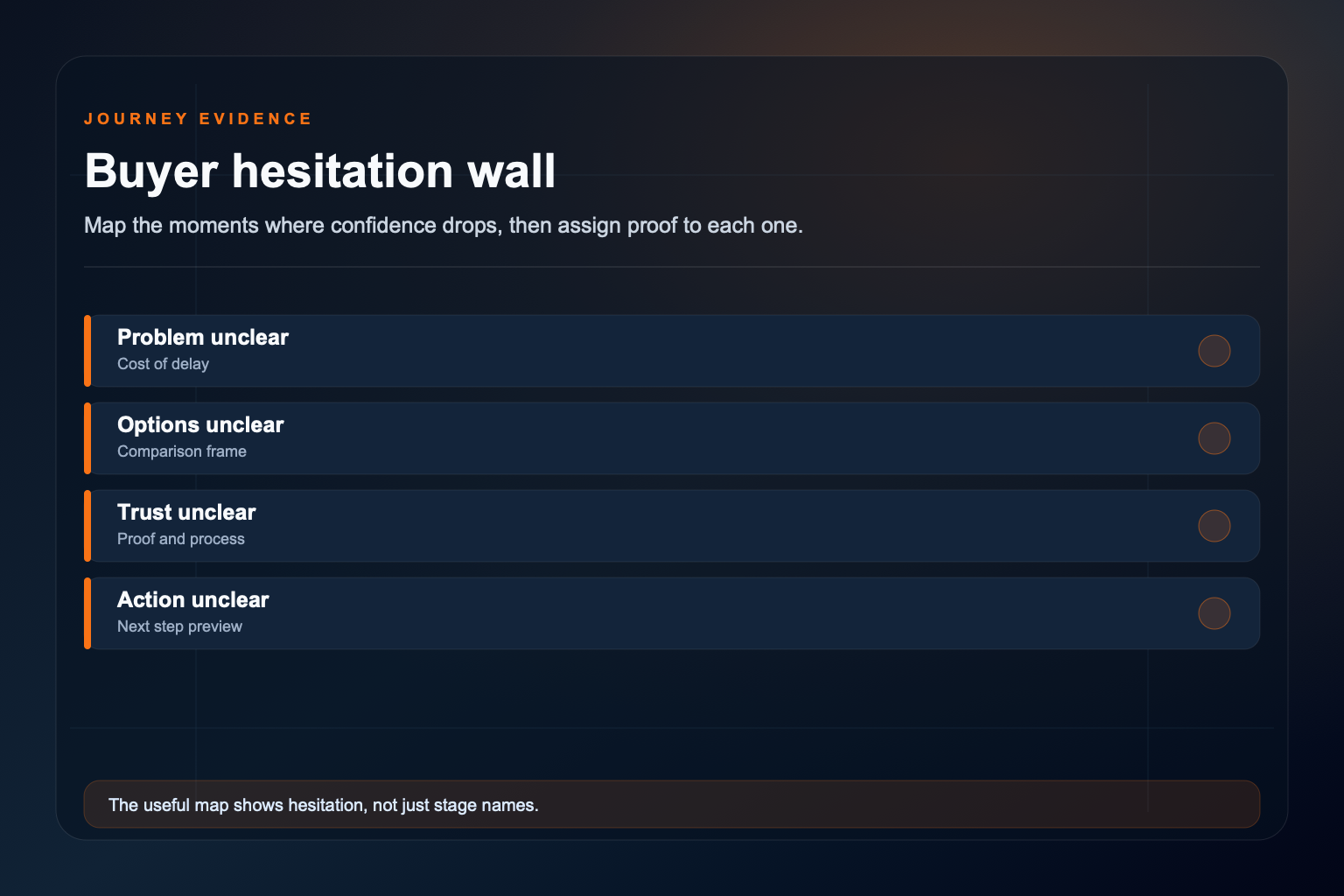
Journey mapping should identify where confidence drops and which proof should repair it.
*The useful map is less about the funnel shape and more about the buyer's next doubt.*
| Buyer stall | What it sounds like | Marketing response |
|---|---|---|
| Problem unclear | "Is this actually worth fixing?" | Name the cost of delay and show common symptoms. |
| Options unclear | "What are my choices?" | Compare approaches without pretending one answer fits all. |
| Trust unclear | "Why should I believe you?" | Show proof, process, reviews, and specific examples. |
| Action unclear | "What happens next?" | Clarify the offer, booking path, timeline, and risk. |
| Value unclear | "Was this worth it?" | Improve onboarding, education, lifecycle follow-up, and repeat prompts. |
Do not turn this into a 30-touchpoint mural. A map with four honest friction points is more useful than a beautiful diagram with every channel in the company.

Connect stages to content jobs
The journey map should change what gets created.
At the problem-aware stage, content needs to name the pain. At the option-aware stage, it needs to explain the approaches and tradeoffs. At the vendor-aware stage, it needs to prove fit. At the action-ready stage, it needs to remove friction and make the next step obvious. After the first purchase or first lead, it needs to deepen trust and reduce regret.
That sounds simple, but it catches a common digital marketing mistake: teams overproduce awareness content and underproduce decision support.
They publish many posts about the broad problem but few pieces that help a buyer compare vendors, understand pricing, prepare for the call, handle internal objections, or know what happens after they convert. The result is a content program that creates attention but not confidence.
For Sparksbox work, the better question is: which asset would make the buyer more comfortable taking the next step?
Examples:
- A service page that explains who the offer is not for
- A comparison guide that explains tradeoffs without attacking competitors
- A checklist that helps the buyer prepare for a call
- A review response system that answers recurring doubts
- A retention email that helps the customer get value after purchase
- A compliance note that names boundaries before sales language gets sloppy
Use behavior as the reality check
Journey maps are guesses until behavior corrects them.
Analytics, CRM notes, search queries, review language, sales calls, support tickets, profile actions, and email replies all reveal where people hesitate. The goal is not perfect attribution. The goal is enough signal to decide which part of the journey needs attention.
If many people visit a pricing page and leave, the issue may be value clarity, offer fit, risk, or next-step friction. If reviews mention confusion about parking, inventory, or service expectations, the local journey has a proof problem.
If email subscribers read education content but do not click the offer, the next step may be too vague. If sales keeps answering the same question, the website or campaign should answer it sooner.
Editor's Note: A journey map should be updated when real buyer behavior contradicts it. The map is not the source of truth. The buyer is.
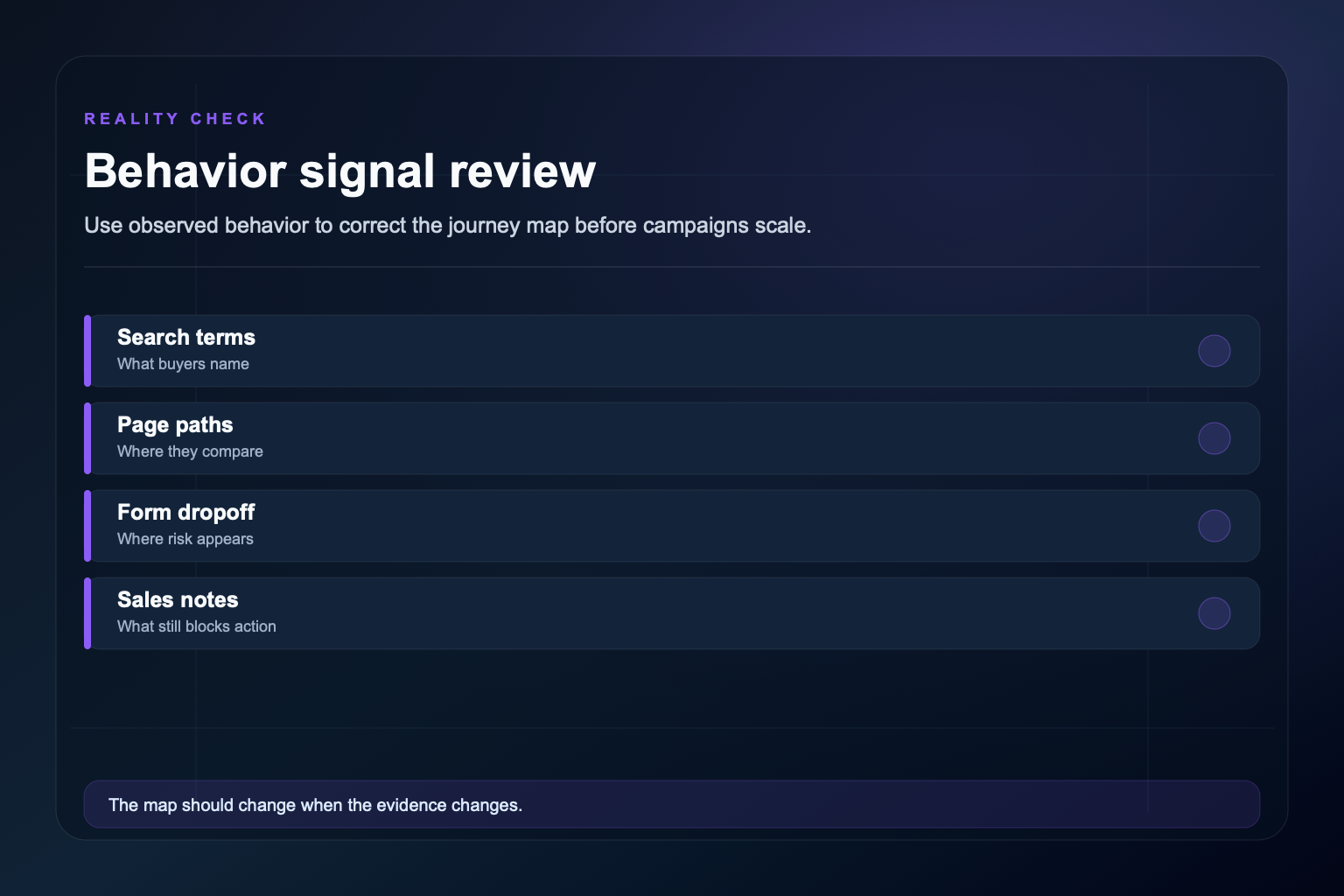
Search terms, page paths, form drop-off, and sales notes can correct the journey map.
*Behavior keeps the map honest when the workshop version looks too clean.*
Keep the map small enough to use
A useful customer journey map can fit on one page:
- 1The buyer decision
- 2The trigger
- 3The stage where the buyer hesitates
- 4The question they need answered
- 5The proof they need
- 6The asset or experience that should help
- 7The metric that tells the team whether friction improved
That is enough.
The map should guide content planning, offer design, channel selection, landing page fixes, review strategy, and measurement. It should also guide what the team stops doing. If a channel or asset does not help the buyer move through the current friction point, it may not belong in the next sprint.
What this means for AI-native marketing
AI can help summarize sales calls, cluster review themes, pull common objections, draft journey hypotheses, and turn raw notes into asset briefs. That is useful. But AI should not replace the judgment step.
If the team asks AI for "a customer journey map," it will produce a tidy funnel. If the team gives AI real inputs from calls, reviews, support tickets, campaign notes, and analytics, it can surface patterns faster.
The better prompt is not "make a journey map." The better prompt is "find the recurring moments where buyers hesitate, list the proof they ask for, and suggest the asset that would remove friction."
That keeps AI in the right role: pattern finder, not strategy owner.
Frequently asked questions
Customer journey mapping in digital marketing is the process of identifying how buyers move from problem awareness to action, including the doubts, proof needs, touchpoints, and barriers that affect the decision. A useful map connects each stage to a marketing asset or experience that removes friction.
It should include the buyer decision, trigger, key stages, questions, objections, proof needs, conversion paths, post-purchase moments, and the metrics used to judge whether friction improved. It does not need to include every possible touchpoint.
A funnel shows the business view of progression. A journey map shows the buyer view of uncertainty, comparison, proof, and action. Funnels are useful for measurement, but journey maps are better for deciding what content, offer, and experience the buyer needs next.
Update the map when buyer behavior, offers, channels, reviews, sales notes, or product experience change. Most teams should revisit the map at least quarterly during strategy review.
AI can help draft and analyze a journey map, especially when it has real customer inputs. It should not invent the journey from generic assumptions. Use AI to cluster friction and patterns, then let the team decide what matters.