A digital marketing measurement plan should not be a dashboard wish list.
Dashboards can be useful. Reports can be useful. Platform metrics can be useful. But the plan itself has one job: help the team make better decisions.
If the team cannot explain what changed, where the source of truth lives, what signal matters, and what decision follows, measurement becomes decoration. The report may look polished, but it will not guide action.
The point of marketing measurement is not to know everything. It is to know enough to decide what to keep, fix, scale, or stop.
This belongs early in the strategy process. A digital marketing strategy should define measurement before launch, not after the campaign has already created messy data.
Start with the decision
Most measurement plans start with metrics. Sessions, clicks, impressions, leads, conversions, calls, bookings, cost per click, email opens, form fills, revenue, repeat purchase.
Those metrics matter only when they answer a decision.
The better sequence is:
- 1What decision will this campaign force?
- 2What outcome is the campaign supposed to influence?
- 3What signal would show progress?
- 4Where will that signal be recorded?
- 5What action will the team take if the signal is strong, weak, or unclear?
For example, if the decision is whether to scale a paid campaign, the team needs more than click-through rate. It needs lead quality, conversion path behavior, sales acceptance, cost, and maybe early revenue. If the decision is whether to keep a retention email, open rate is not enough. The team needs repeat purchase, unsubscribe, complaint, and customer response signals.
Measurement starts to work when every metric has a decision attached.

Define the conversion hierarchy
Not every conversion is equal.
A useful plan separates primary conversions, secondary conversions, and diagnostic signals.
The primary conversion is the action closest to the business objective. A qualified demo, booked consultation, completed purchase, direction request, repeat purchase, sales accepted lead, or renewal action may be primary depending on the business.
Secondary conversions show useful intent but should not become the scoreboard. Guide downloads, email sign-ups, profile clicks, video views, and pricing page visits may matter because they reveal movement.
Diagnostic signals explain what may be helping or blocking the primary outcome. Page speed, form drop-off, source quality, review themes, phone answer rate, landing page scroll, and CRM stage movement can all matter.
This hierarchy prevents metric soup. Without it, every number competes for attention and the team can always find one metric that looks good.
| Metric layer | What it answers | Example |
|---|---|---|
| Primary conversion | Did the business outcome move? | Qualified call, purchase, repeat purchase |
| Secondary conversion | Is the buyer moving closer? | Pricing page view, guide request, booking click |
| Diagnostic signal | What should we fix? | Form drop-off, call miss rate, source mismatch |
Pick a source of truth
No platform should be treated as neutral just because it has a report.
Ad platforms, analytics tools, call tracking, CRM systems, ecommerce platforms, point-of-sale systems, booking tools, and email platforms each see part of the journey. They may define conversions differently. They may attribute credit differently. They may miss offline or delayed events.
A measurement plan should name the source of truth for each decision.
For revenue, the source of truth may be the CRM, ecommerce platform, POS, or accounting system. For site behavior, it may be analytics. For phone leads, it may be call tracking plus CRM disposition. For local actions, it may be Google Business Profile performance combined with call and booking data. For lifecycle, it may be the email platform plus purchase history.
Google's GA4 event model can help teams track meaningful site actions, but the event still needs a business definition. A button click is not a qualified lead unless the downstream system confirms it.
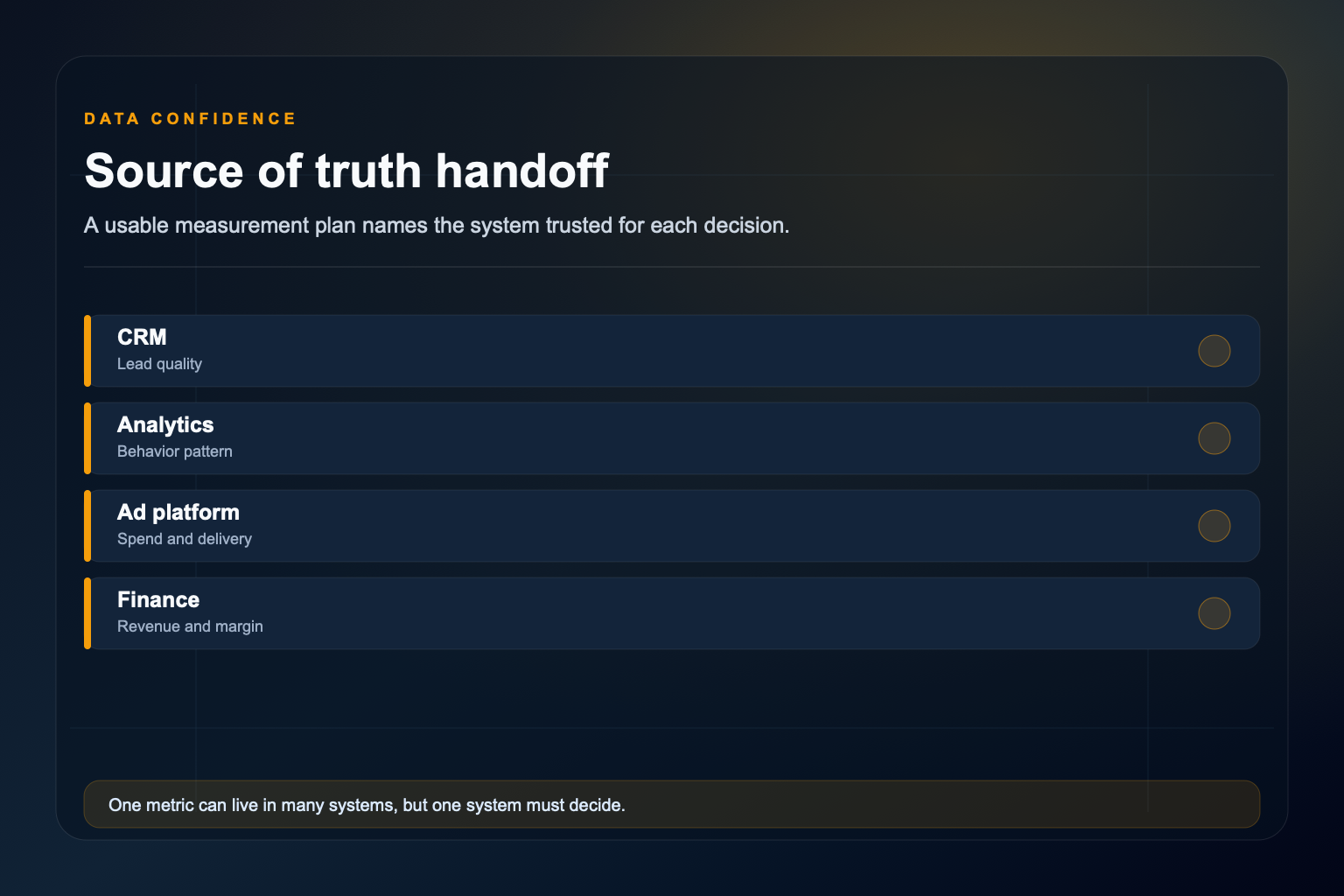
Measurement plans need a source of truth for each decision, not just another dashboard view.
*One metric can appear in many systems, but the team has to know which one decides.*
Build decision rules before the campaign
The team should know what it will do when data arrives.

Decision rules can be simple:
- Keep if the signal is strong and the economics are acceptable.
- Fix if intent exists but friction appears in the path.
- Scale if quality holds as volume rises.
- Stop if the campaign fails to create learning or useful action.
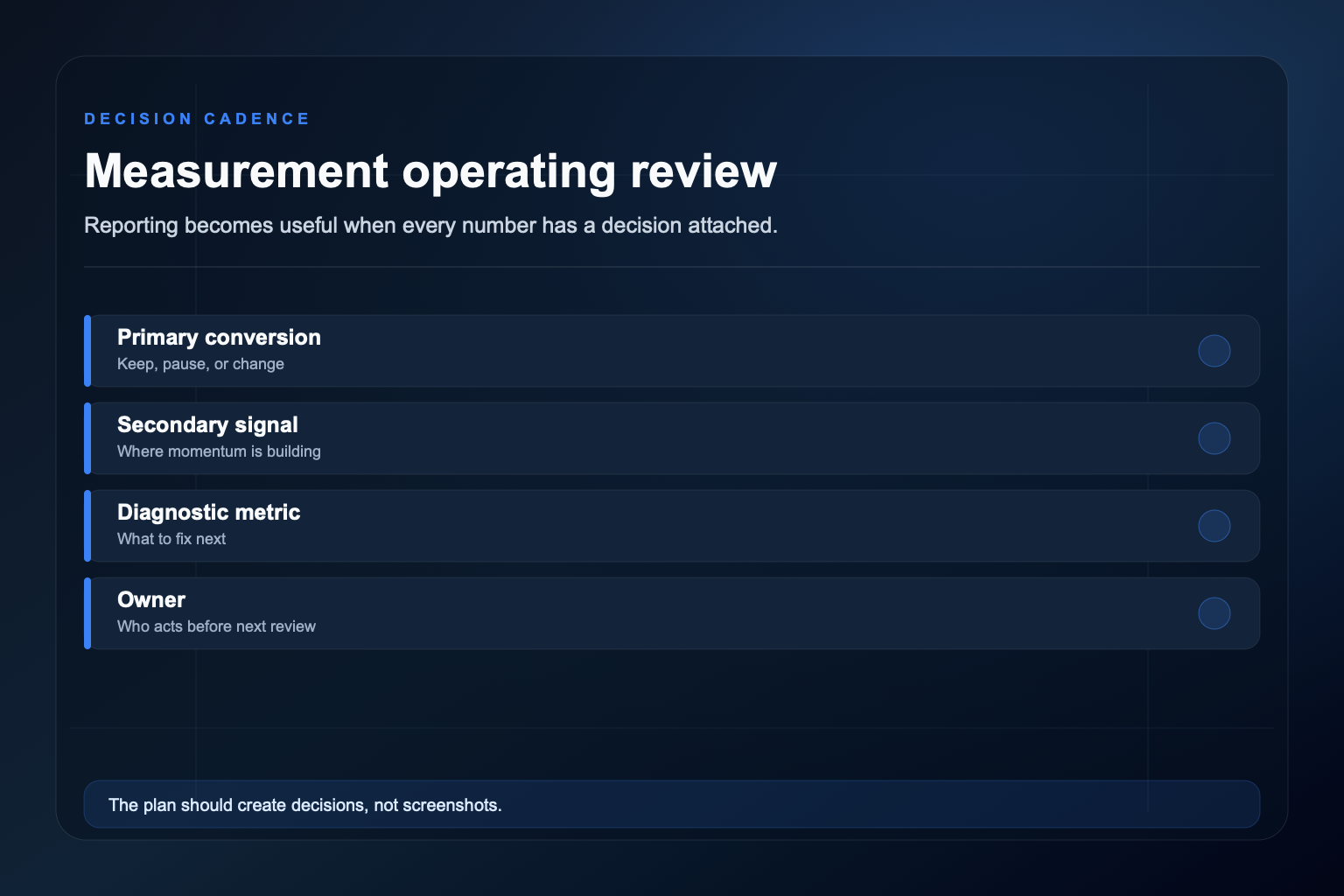
A useful measurement review connects each number to a decision, owner, and next action.
*Measurement earns its place when it changes what the team keeps, fixes, scales, or stops.*
This avoids retroactive storytelling. If the team only decides what success means after the campaign runs, the report becomes politics.
A good rule includes the time window, the metric, the threshold or qualitative signal, and the decision. The rule does not have to be perfect. It has to make the next conversation more honest.
Use cadence to create learning
Measurement without cadence becomes a pile of snapshots.
Daily checks are useful for spend, errors, broken tracking, lead routing, and urgent issues. Weekly checks are useful for campaign learning, creative performance, conversion path friction, and sales feedback. Monthly reviews are useful for budget allocation, offer performance, channel mix, and business impact. Quarterly reviews are useful for strategy.
The mistake is using the same meeting for every decision. A daily pacing issue should not become a strategy debate. A quarterly strategy review should not get lost in one ad set.
The cadence should match the decision.
Measure quality, not just quantity
More leads can hide a weaker business outcome.
If lead volume rises but sales acceptance falls, the campaign may be widening the wrong audience. If purchase volume rises but repeat rate falls, the offer may be attracting low-fit buyers.
If profile clicks rise but phone calls are missed, the issue may be operations rather than marketing. If traffic grows but high-intent pages do not convert, the issue may be proof, offer clarity, or journey friction.
Measurement should connect marketing data to operational reality.
This is especially important in regulated or complex categories. A campaign may generate engagement while also creating compliance risk, support confusion, or low-quality inquiries. The scoreboard has to include quality signals, not only volume.
Keep the report human
The best measurement plan is simple enough for leadership, sales, operations, and marketing to use together.
Do not bury the team in a dashboard that only the analyst understands. Use a short operating report:
- What changed?
- What did we learn?
- Where is the source of truth?
- What decision follows?
- What needs to be fixed before the next readout?
Editor's Note: If a metric will not change a decision, it can usually move to the appendix or disappear.
What this means for AI-native marketing
AI can summarize reports, spot anomalies, classify call notes, cluster objections, and draft weekly readouts. That is valuable. But AI can also create false confidence when the underlying source of truth is weak.
Before using AI to narrate performance, define the events, sources, naming rules, and decision cadence. Otherwise the tool will turn messy data into polished uncertainty.
The AI advantage is not a prettier report. It is faster pattern recognition once the measurement plan is clean.
Frequently asked questions
A digital marketing measurement plan defines the conversions, source of truth, reporting cadence, leading indicators, lagging indicators, and decision rules used to judge marketing performance. It explains how the team will decide what to keep, fix, scale, or stop.
It should include primary conversions tied to the business objective, secondary conversions that show buyer movement, and diagnostic signals that explain friction. The exact metrics depend on the business goal, channel mix, customer journey, and sales process.
Different platforms count actions differently. A source of truth prevents the team from arguing over platform reports and helps connect marketing activity to sales, revenue, retention, or operational outcomes.
Use daily checks for spend and tracking errors, weekly reviews for campaign learning, monthly reviews for allocation and offer decisions, and quarterly reviews for strategy. The cadence should match the decision being made.
AI can help summarize performance, detect patterns, classify feedback, and draft reports. It should sit on top of clean tracking, clear definitions, and reliable source systems. It cannot fix untrustworthy data by itself.