Many campaigns fail before the ad ever runs.
The audience might be reasonable. The channel might fit. The creative might look good enough. The landing page might even load quickly. But the offer is vague, low-trust, or too hard to understand.
"Book a call." "Get started." "Learn more." "Shop now." Those can work when demand is already strong and the buyer understands exactly what they get. Most of the time, they leave too much work for the buyer.
A marketing offer is not just a discount or promotion. It is the reason a person should take the next step now.
The offer is where strategy becomes a concrete decision for the buyer.
If the offer is unclear, reporting gets muddy. A lead does not mean much if the buyer did not understand the call. A sign-up is weak if the next step was hidden. A paid campaign cannot teach much if the conversion is too vague to diagnose.
This is why offer strategy belongs before media spend, not after it. It sits between the business goal and channel plan and determines whether attention can turn into useful action.
Define the job of the offer
The first question is not "What CTA should we use?" It is "What job should this offer perform?"
Different offers do different jobs:
- An awareness offer helps the buyer understand the problem.
- A comparison offer helps the buyer evaluate approaches.
- A trust offer helps the buyer believe the company can deliver.
- An action offer helps the buyer take the next step.
- A retention offer helps the customer return, reorder, reactivate, or deepen usage.
Most campaigns ask for action too early. They send cold attention to a hard conversion before the buyer understands the problem, trusts the brand, or knows what happens next.
That does not mean every campaign needs a long funnel. It means the offer should fit the decision moment.
For a local service business, a direct booking may work because the need is urgent. For a complex B2B service, a diagnostic, audit, comparison guide, or strategy session may be more believable.
For a skincare brand, a routine finder or replenishment reminder may outperform another discount. For a regulated industry, an assessment or eligibility check may be safer than a broad promotional promise.

Answer the four offer questions
A strong offer answers four questions quickly.
- 1What problem is this solving?
- 2Who is it for?
- 3What happens after someone responds?
- 4Why is this a low-risk next step?
If any answer is missing, the buyer has to infer too much.
"Book a call" does not answer the problem. It does not say who the call is for. It does not say what happens after the form. It does not reduce risk.
"Book a 30-minute local visibility audit for multi-location businesses" is better. The buyer knows the topic, format, audience, and time commitment. It still may need proof, but at least the conversion has a shape.
The same logic applies to ecommerce and retention. "Get 10% off" may create urgency, but it does not always create confidence. "Build your refill routine before day 45" gives the customer a clearer reason to return. "Find the right starter set for sensitive skin" gives a new buyer a safer path than a generic product grid.
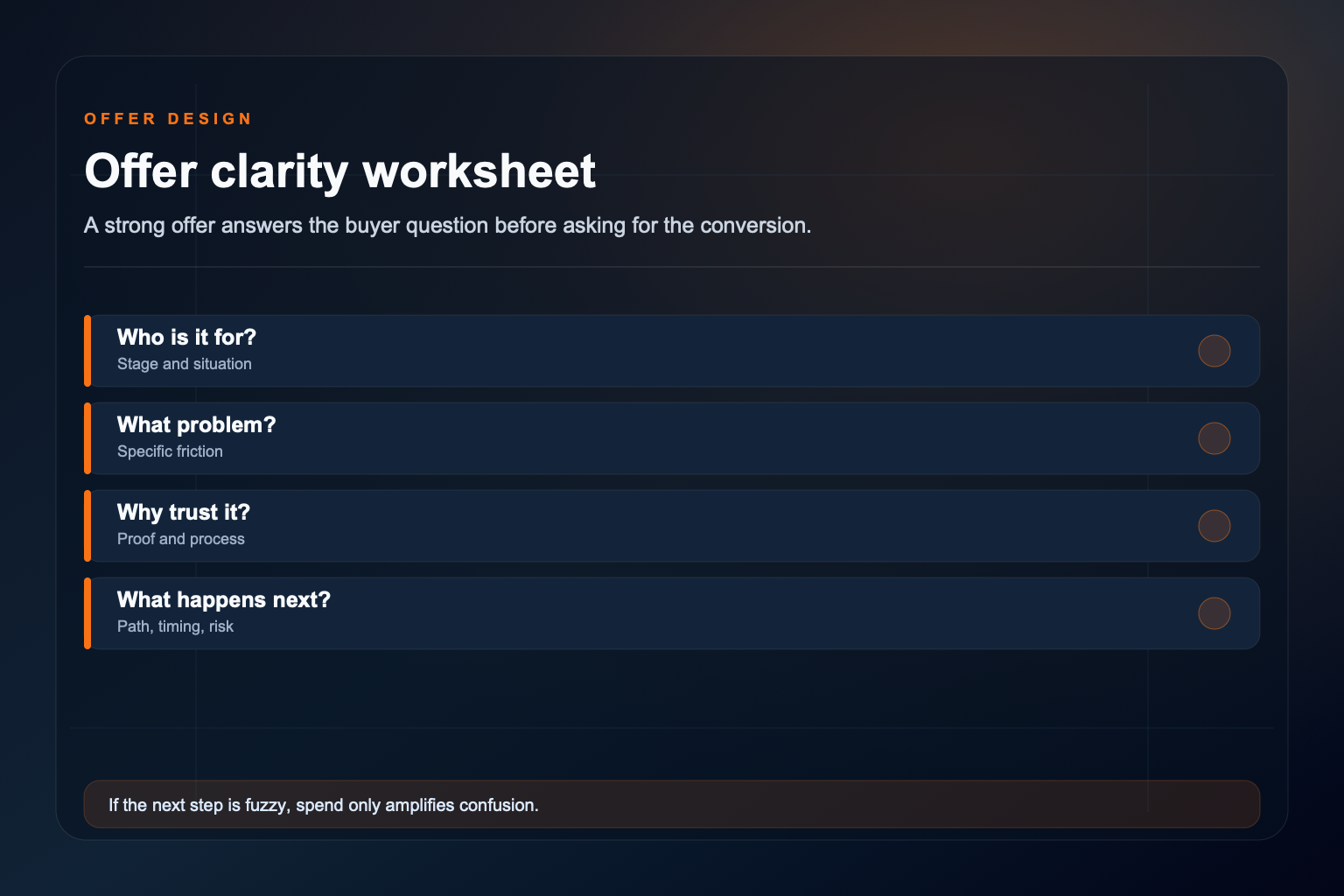
Offer strategy should answer the buyer, problem, proof, and next-step questions before media spend increases.
*A stronger offer makes the next step easier to understand before the campaign asks for action.*
Make the next step visible
Offer strategy is partly about reducing uncertainty after the click.
What happens after the form? Who follows up? How long does it take? Is there a cost? Is it a sales call, a diagnostic, a demo, a quote, a sample, a guide, a trial, a pickup, or a consultation? What information does the buyer need to provide? What should they expect to receive?
The more complex the service, the more important this becomes.

If the buyer cannot picture the next step, they may delay even when they are interested. That is not a channel problem. It is an offer clarity problem.
The landing page should reinforce the offer with:
- A plain-language headline
- A specific promise
- Who the offer is for
- Who it is not for, when useful
- The expected time commitment
- What happens after the response
- Proof that makes the step credible
- A simple form or booking path
For Sparksbox services, this means the offer should not pretend every prospect needs the same thing. A strategy audit, AI workflow review, local visibility cleanup, or retention system build may each need a different entry point.
Do not hide a weak offer behind better creative
Better creative can help, but it cannot rescue an offer that does not make sense.
When campaigns underperform, teams often respond by changing the headline, image, channel, or targeting. Those are valid tests. But if every version points to the same vague next step, the team may only be testing wrappers around the same weak offer.
Symptoms of offer weakness include:
- Lots of clicks but few meaningful conversions
- Form fills that do not understand what they requested
- Sales calls with poor fit
- High bounce after the offer section
- Repeated questions about what happens next
- Discount-driven buyers who do not repeat
- Campaigns that only work when incentives are high
The fix is to make the offer more specific, not louder.
Match offer risk to buyer risk
Every buyer senses risk. Money risk. Time risk. Reputation risk. Operational risk. Compliance risk. Emotional risk. The offer should reduce the specific risk that blocks action.
For a small business owner, the risk may be wasting money on another agency. For an operations lead, the risk may be adding more work to an already overloaded team.
For a regulated business, the risk may be public claims, platform policy, or approval mistakes. For a consumer, the risk may be buying the wrong product, missing a deadline, or not knowing whether the brand can deliver.
Low-risk does not mean low-value. It means the step feels reasonable for the stage.
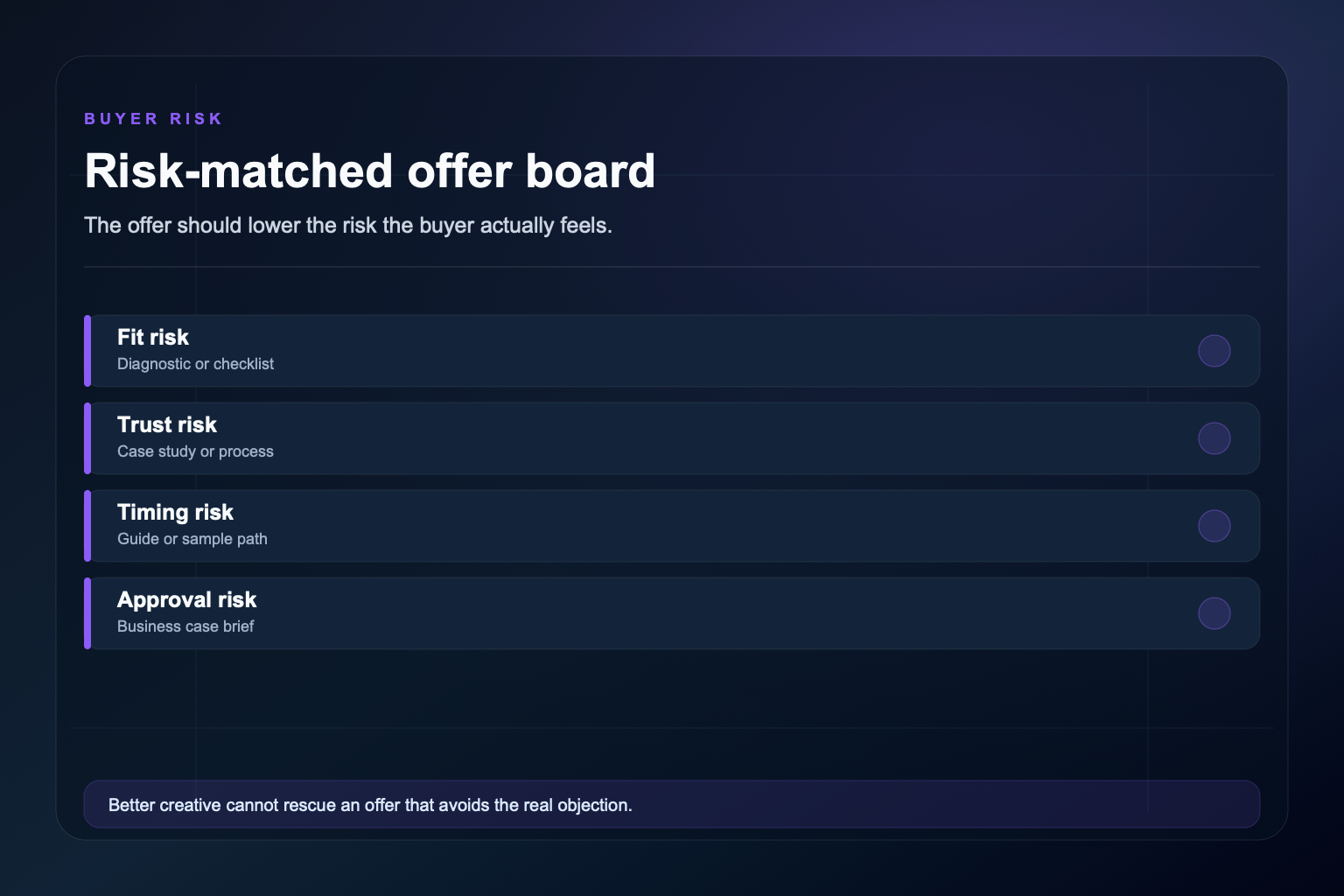
The right offer lowers the specific risk that keeps the buyer from taking the next step.
*The offer should reduce the risk the buyer actually feels, not the risk the team prefers to talk about.*
Examples:
| Buyer risk | Better offer direction |
|---|---|
| "I do not know if this fits us." | Diagnostic, audit, fit check, comparison guide |
| "I do not trust the promise yet." | Case study, process walkthrough, review proof |
| "I am not ready to buy." | Educational guide, checklist, calculator, sample path |
| "I need internal approval." | Business case, one-page brief, stakeholder summary |
| "I might not use it." | Onboarding support, routine builder, reminder sequence |
Measure offer quality, not just lead volume
The offer should be measured by the quality of action it creates.
Lead volume matters only if the leads are usable. Discount usage matters only if the customers keep buying. Downloads matter only if they move the buyer closer to a decision. A call booking matters only if the buyer understood the conversation they booked.
Offer metrics should include:
- Conversion rate
- Qualified conversion rate
- Sales acceptance
- Show rate
- Time to first response
- Close rate
- Repeat purchase
- Unsubscribe or refund signals
- Common objections after conversion
That last one is underrated. Objections after conversion often reveal what the offer failed to explain before conversion.
What this means for AI-native marketing
AI can generate dozens of CTAs and landing page versions. It can also multiply weak offers very quickly.
Use AI to stress-test:
- What the buyer thinks they are getting
- Which risk the offer reduces
- What objections remain unanswered
- Whether the CTA matches the stage
- Whether the promise is too broad
- Whether the next step is visible
Then use it to draft variations.
The order matters. Offer clarity first, copy variation second.
Frequently asked questions
A marketing offer is the specific next step a buyer is asked to take and the reason that step is valuable now. It can be a consultation, audit, trial, guide, discount, demo, product bundle, assessment, booking, or retention prompt.
No. A discount is one type of offer, but many strong offers are not price reductions. A clearer consultation, diagnostic, starter kit, comparison guide, routine builder, or proof asset can outperform a discount when the buyer needs confidence more than price relief.
Media spend amplifies the offer. If the offer is vague, the campaign may create attention without useful action. Clarifying the offer first makes channel tests easier to interpret and improves conversion quality.
Signs include low conversion, poor lead quality, repeated buyer confusion, high drop-off after the offer section, low show rate, weak repeat purchase, or sales conversations where prospects misunderstood what they requested.
Yes. AI can pressure-test buyer objections, generate offer variations, summarize sales call friction, and draft landing page copy. It works best after the team defines the buyer, problem, next step, and risk.